Location
Germany, Bavaria, Tegernsee
Parish Church of St Quirinus in Tegernsee (Ehem. Kloster- und heutige Pfarrkirche St. Quirin)
Catholic Parish of St Quirinus
Artwork
The Sculptures of the Side Altar of St Benedict in the Parish Church of St Quirinus in Tegernsee
Type
Side altar
Critical History
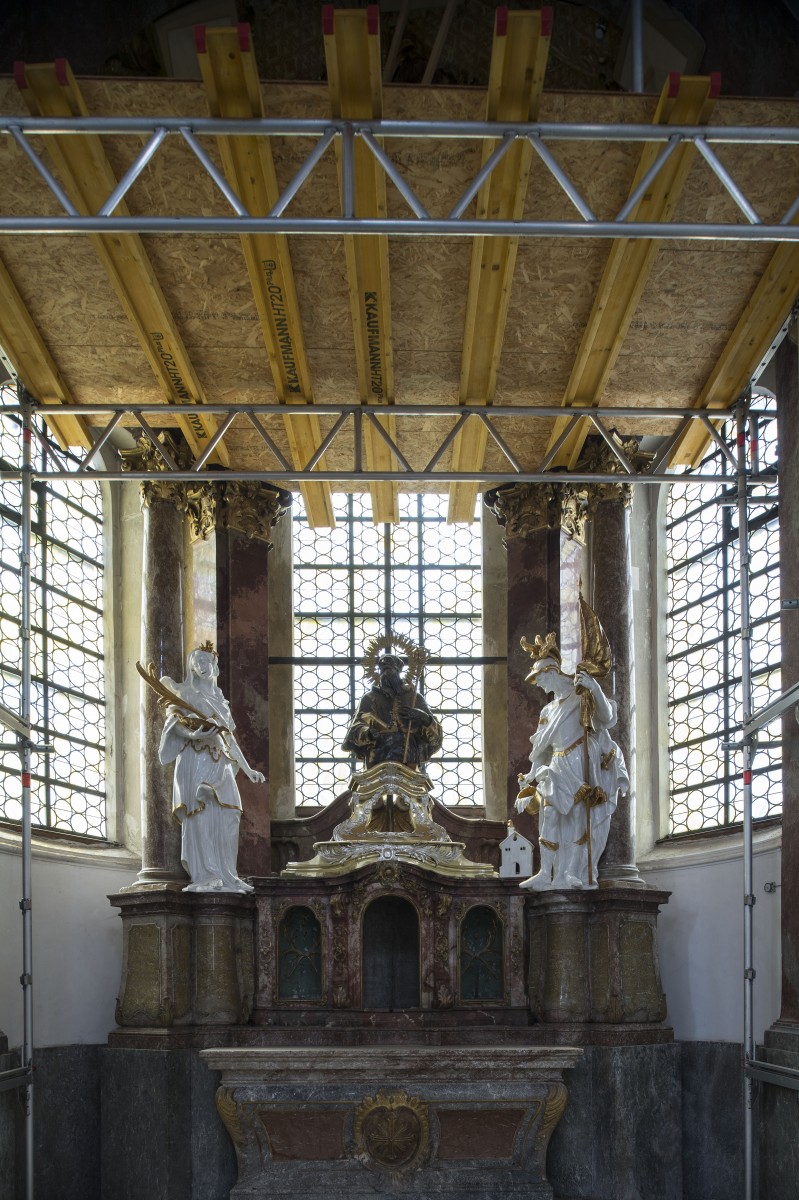
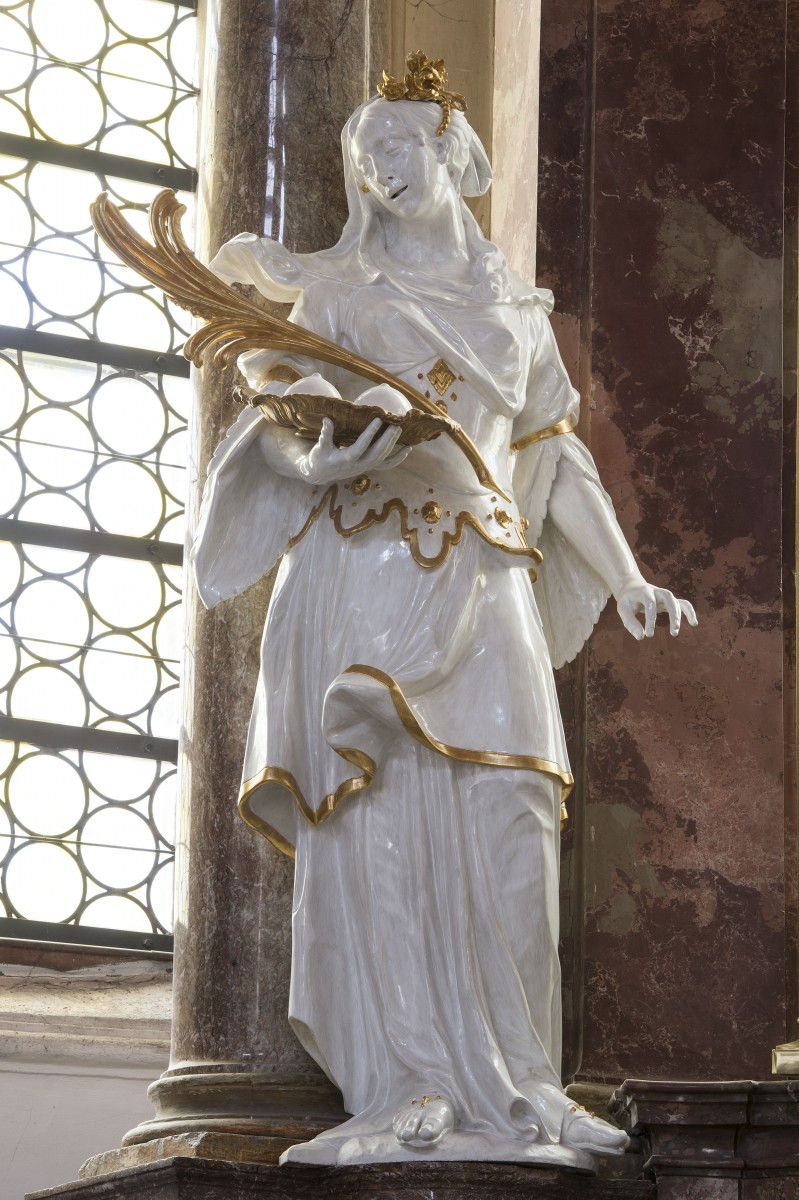
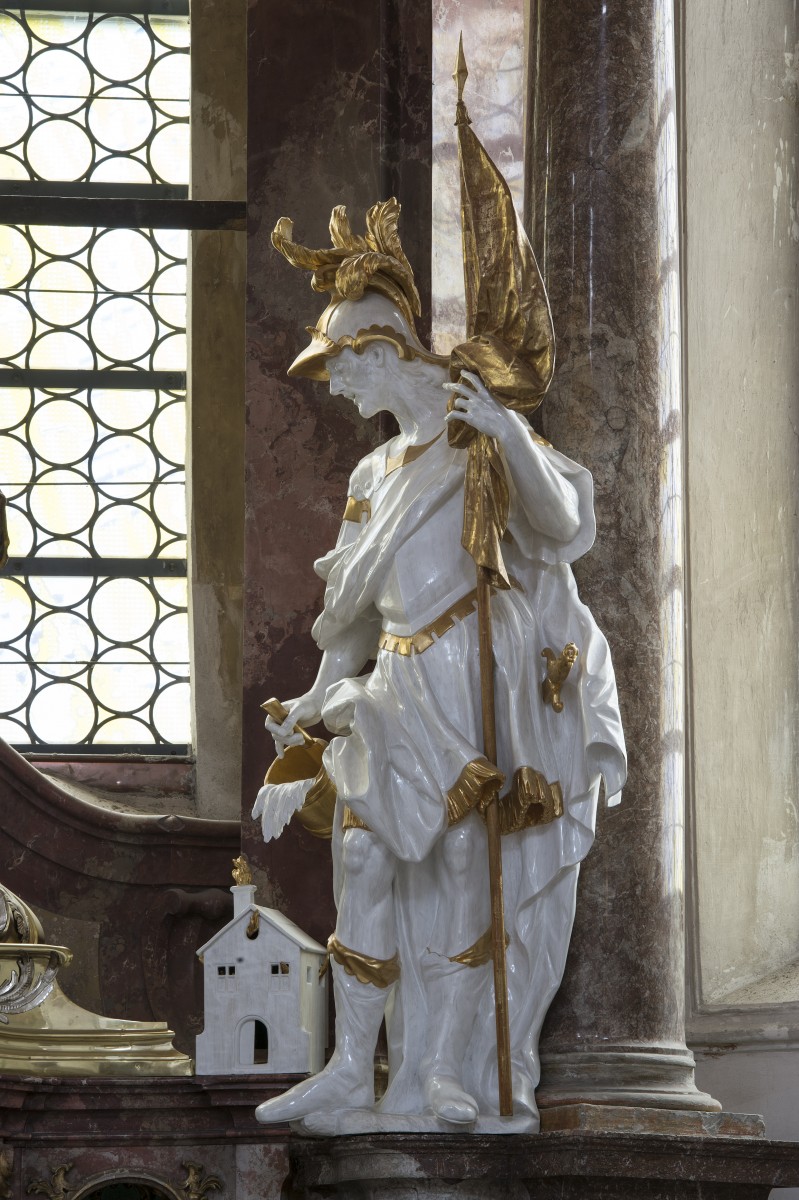
In the list of J. C. Lippert the 5 sculptures are registered under number 50 and 51.1 S. Agatha, St Florian, St Rochus, St Sebastian and a bust of St Benedict are part of the 2 sidealtars dedicated St Benedict and St Quirinus. The center of the altar dedicated St Benedict is the bust of St Benedict. Two small sculptures representing St Placidus and St Maurus are presented in two niches of the predella behind glass of the altar dedicated St Benedikt. They are not attributed to an sculpturor. The sculptures representing St Agathe and St Florian belong also to this altar. Both altars were erected in 1748 by marble combined with stucco. The architecture is partially decorated with metal ornaments in silver and gold. The tabernacles are made by gilded copper. The stucco of the altar and the reliefs at the walls and the ceiling were made by M. J. G. Üblher (1703–1763).2 Concerning the date of origin of the sculptures N. Lieb supposes a connection with the 1000 years anniversary of the monastery in 07. 7. 1753.3 R. Götz says that the anniversary was held in 1746.4
Construction / Execution
The 2 chapels are an exellent work of art which integrate the altars made by marble and stucco marble into the decoration of the walls and the ceiling. The light from outside was originally changed artificially by a yellow glass. In 19 th century there was installed coloured glass windows in 20th they were replaced by white glass. Puttos made by white stucco imitating white marble are flying above. The 2 sculptures representing St Agathe and St Florian are carved in wood. St Agathe H 162,5cm W 63cm D 47,5cm; S. Florian H 176,5cm W 75,5cm D 44,5cm. The painting layer is a polished white combined with watergilded parts and imitates again marble or alabaster. The original white was polished and combined with a watergilding on a orange bole. A ground layer with dolomite and a thin layer with chalk follwed by leadwhite was documented. Dimensions of the bust representing St Benedict H 83cm W 75cm D 64cm.
Components
- Sculpture
- The sculptures of the side altar of St Benedict in the Parishchurch St Quirin, Tegernsee
- Author: Johann Baptist Straub (Wiesensteig ca. 1704 – Munich 1784)
- Completed: 1746 – 1748
- Technique(s): wood carving
- Polychromy
- The sculptures of the side altar of St Benedict in the Parishchurch St Quirin, Tegernsee
- Completed: 1746 – 1748
- Technique(s): polished white, water gilding
- Material(s): Bologna chalk, Champagne chalk, gold leaf, lead white, skin glue
- Polychromy
- The sculptures of the side altar of St Benedict in the Parishchurch St Quirin, Tegernsee
- Completed: 1824 – 1825
- Technique(s): oil
- Polychromy
- The sculptures of the side altar of St Benedict in the Parishchurch St Quirin, Tegernsee
- Completed: 1946
- Polychromy
- The sculptures of the side altar of St Benedict in the Parishchurch St Quirin, Tegernsee
- Completed: 1902
- Technique(s): oil
- Polychromy
- The sculptures of the side altar of St Benedict in the Parishchurch St Quirin, Tegernsee
- Completed: 1998 – 2008
- Technique(s): polished white, water gilding
- Material(s): Bologna chalk, bone black, Champagne chalk, gold leaf, gold powder, lead white, red bole, skin glue, watercolours, yellow bole
Comment
The chapel of St Benedict is not yet restored because there are static problems with the underground of the chapel. The 4 sculptures wooden sculptures with a monochrome white painting layer combined with a water gildung were removed from the altars in 1879. In 1902 they were rediscovered restored and placed on consoles apart from the altars. In 1946 they were overpainted and came back to the altars but not in the original positions. In that period the position of the head of St Benedicts bust was changed from the inclined position into a straight looking one. The higher position was reduced by removing the lower part of the pedestal (documented by a foto). Because of that the head was interpreted by arthistorians to be a younger addition. In context with the complete restoration of the church (1998–2004) the sculptures were examined in the workskop of Bavarian State Department of Monuments and Sites in 1998 and restored in 2004. In 2008 after the last restoration of the 4 white sculptures by a freelance restorer they came back into their original position proved by archival documents. After finding out that the original positon of the head was inclined to the left this position was reconstructed. The painting layer was conserved. It dates into the middle of the 18th centurry. The oil silver on the head executed in 1946 was not removed. From archival documents we know that there was a second bust made in 1765 by a silver-smith called Joseph Reichenzein. The silver-bust was only presented on the occasion of high church festivals. The 2 sculptures in the niches of the predella have a rare original polished black painting layer combined with water gilding and impact metal. There is another !8th century bust representing the Sacred Heart of Jesus which similarities with the style of J.B. Straub.
Conservation-restoration
- 1824
Approach to the presentation of losses
Repolychroming: total
Treatment Description
In 1824/25 the complete sculptural equipment received a new white painting layer in oil with oil gilding.
- 1902
Strategy: removing one or several historic repolychromies
Approach to the presentation of losses
Repolychroming: total
Treatment Description
In 1902 the 4 sculptures were found on the loft of the church. They were restored by the so called Mayersche Hofkunstanstalt in Munich. The original white painting layer was almost completely removed and they were overpainted in a polished white combined with a watergilding.
- 1946
Approach to the presentation of losses
Repolychroming: total
Treatment Description
The 4 sculptures received a new "white Lacquer" (modern binding media).
- 1998
Strategy: removing one or several historic repolychromies
Approach to the presentation of losses
Repolychroming: partial
Materials: Bologna chalk, bone black, Champagne chalk, gold leaf, gold powder, gouache, green earth, lead white, red bole, skin glue, sturgeon glue, watercolours
Treatment Description
After removing the younger overpainting layers the original polished lead white layer and the watergilding of the 18th century was conserved. The reconstruction of the polished lead white followed receips from 18. th century. On the other hand there was a colouring of the ground layer to be as close as possible to the colour of the puttos made by stucco.
Images
- The side altar of St Benedict in the Parish Church of St Quirinus, Tegernsee (Bavarian State Department of Monuments and Sites, photo by Michael Forstner, 2017)
- The sculpture of St Agatha in the altar of St Benedict in the Parish Church of St Quirinus, Tegernsee (Bavarian State Department of Monuments and Sites, photo by Michael Forstner, 2017)
- The sculpture of St Florian at the altar of St Benedict in the Parish Church of St Quirinus, Tegernsee (Bavarian State Department of Monuments and Sites, photo by Michael Forstner, 2017)
Catalogue entry prepared by Rupert Karbacher
Recommended citation: Rupert Karbacher, The Sculptures of the Side Altar of St Benedict in the Parish Church of St Quirinus in Tegernsee, in: TrArS – Tracing the Art of the Straub Family, 2018, (accessed 26/01/2026) URL
