Location
Germany, Baden-Württemberg, Wiesensteig
Artwork
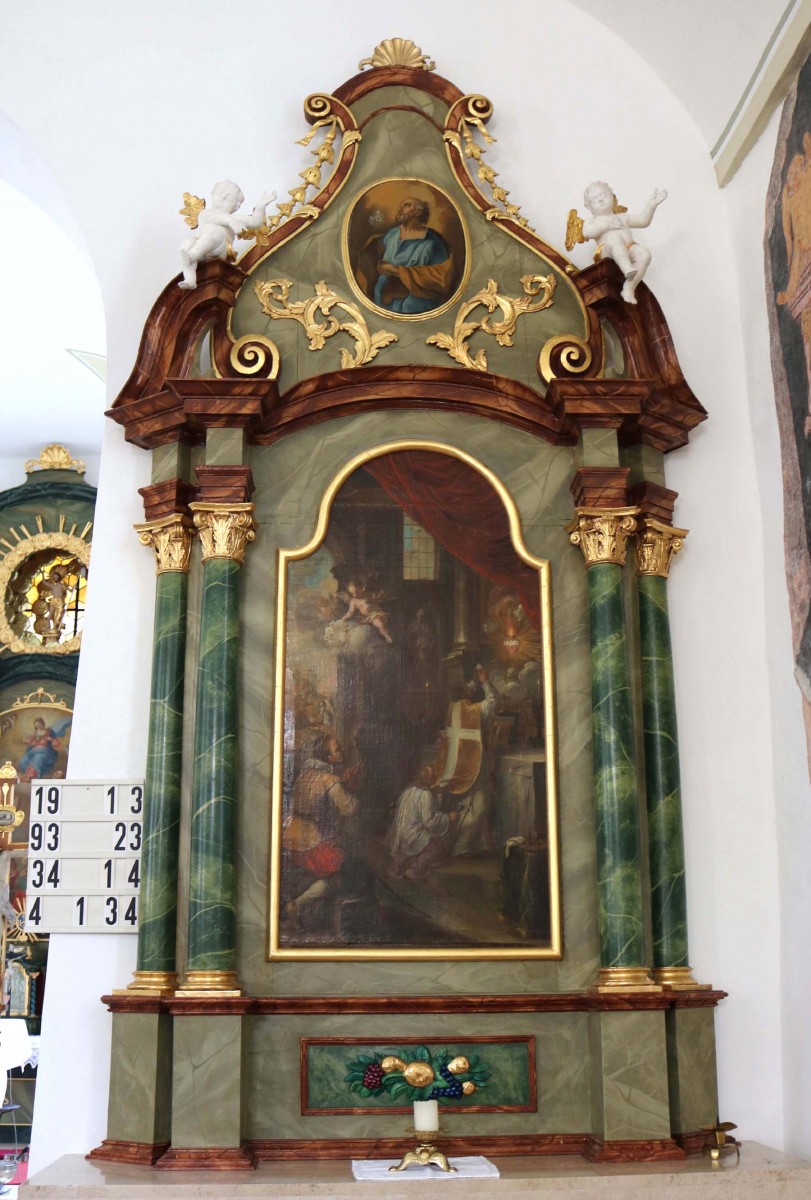
Right Side Altar in the Cemetery Chapel of St Leonard in Wiesensteig
Type
Side altar
Critical History
The cemetery chapel in Wiesensteig dedicated to St. Leonard was probably erected in the 14th century, but mentioned for the first time only in 1432; some alterations were made in 1592 and the great fire from 1648 must have damaged the chapel because an altar was consecrated in 1658.1 According to the account books of the cemetery church, in 1737 they extended the building and added a little tower; in the same year the shriners Johann Georg Straub the Elder and his brother Johannes Straub were commissioned with a new Baroque interior. In 1738 Johann Georg was paid 272 fl. 52 xr. in total for the pulpit (including polychromy), nine church pews, the choir stalls, the church door (including paint), the crucifix and one of the side altars (with polychromy); Johannes Straub delivered some more church pews, the high altar and one side altar with polychromy for 244 fl. 24 xr. in 1738 and in 1743 Johannes Straub made a new tabernacle for the cemetery chapel ("auf den Gottesakher"). Johann Georg Straub was paid for the gilded decoration of the high altar in 1747.2 The two Straub brothers were responsible for the carpentry as well as for the polychromy, the gilding and most of the sculptural and decorative woodcarving for the altars. Which of them worked on the right side altar is not documented.
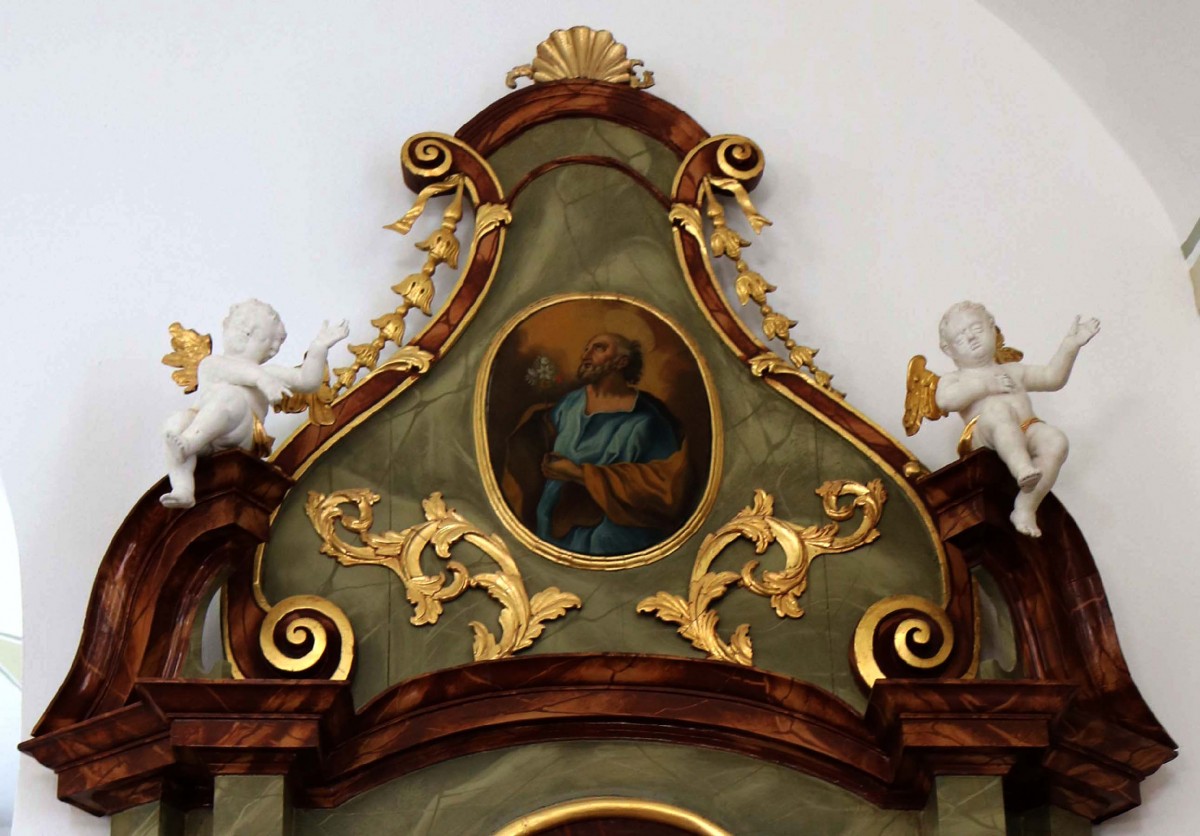
The altar shows a variation of late Baroque architecture with some stylistically retarding elements (acanthus, garlands of fruits). The altarpiece depicts a saint with pilgrimage hat and staff, who during holy mass has a vision of the Immaculate Heart of the Virgin Mary; the heart is burning, it is girdled with a rosary and pierced through with a sword. In the aedicula is a painting of St John with a lily.
Construction / Execution
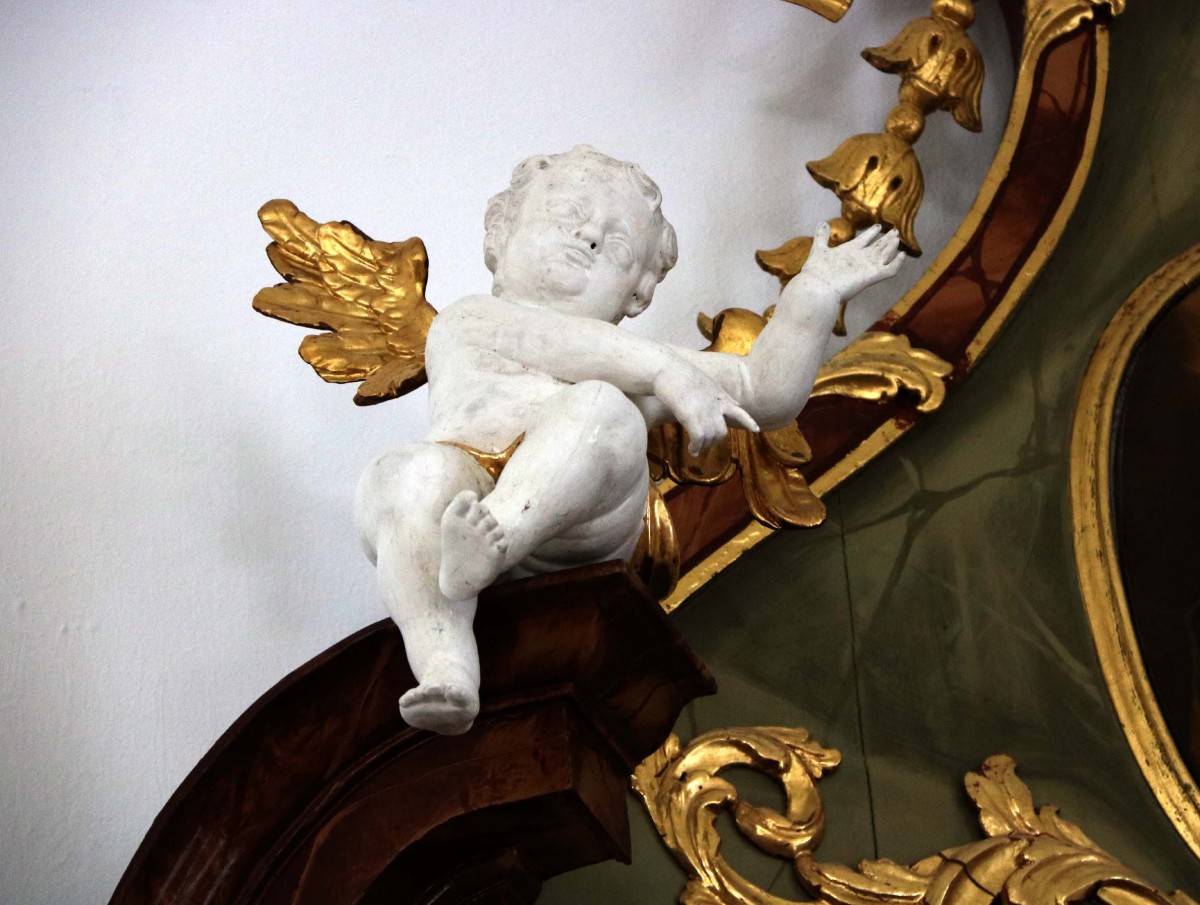
The altar consists of a mensa, a retable with an altar painting flanked by two columns, and above the strutted gable, an aedicula with an oval painting flanked by two angels. The polychromy imitate green and brown marble, the capitals and base of the columns as well as the ornamental decoration are gilded. The two angel-putti are in polished white and partially gilded.
Components
- Carpentry
- Author: (the Elder) Johann Georg Straub (Wiesensteig 1674 – Wiesensteig 1755)
- Completed: 1737 – 1738
- Patron(s): Collegiate Chapter of St Cyriacus, Wiesensteig, chapter
- Technique(s): sawing, wood carving
- Carpentry
- Author: Johannes Straub (Wiesensteig 1681 – Wiesensteig 1759)
- Completed: 1737 – 1738
- Patron(s): Collegiate Chapter of St Cyriacus, Wiesensteig, chapter
- Technique(s): sawing, wood carving
- Material(s): wood
- Sculpture
- Completed: 1737 – 1738
- Patron(s): Collegiate Chapter of St Cyriacus, Wiesensteig, chapter
- Technique(s): wood carving
- Material(s): wood
- Polychromy
- Author: Johannes Straub (Wiesensteig 1681 – Wiesensteig 1759)
- Completed: 1738 – 1738
- Patron(s): Collegiate Chapter of St Cyriacus, Wiesensteig, chapter
- Polychromy
- Author: (the Elder) Johann Georg Straub (Wiesensteig 1674 – Wiesensteig 1755)
- Completed: 1738 – 1738
- Patron(s): Collegiate Chapter of St Cyriacus, Wiesensteig, chapter
- Painting
- Vision of the Immaculate Heart of St Mary
- Patron(s): Collegiate Chapter of St Cyriacus, Wiesensteig, chapter
- Technique(s): oil on canvas
Conservation-restoration
- 1969
Treatment Description
From 1968 to June 1969, architect Paul Anschütz (Wiesensteig) and painter Lothar Bohring (Kirchheim) restored the chapel.3
Images
- The right side altar in St Leonard's chapel, Wiesensteig (photo by Julia Strobl, 2018)
- Angel on the left side (photo by Julia Strobl, 2018)
- The aedicula on the right side altar (photo by Julia Strobl, 2018)
Catalogue entry prepared by Julia Strobl
Recommended citation: Julia Strobl, Right Side Altar in the Cemetery Chapel of St Leonard in Wiesensteig, in: TrArS – Tracing the Art of the Straub Family, 2018, (accessed 24/01/2026) URL
