Location
Austria, Styria, Graz
Alte Galerie, Universalmuseum Joanneum, Inv.-Nr. P 186, not exhibited
Original location:
Austria, Styria, St. Radegund bei Graz
Artwork
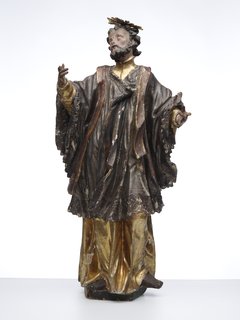
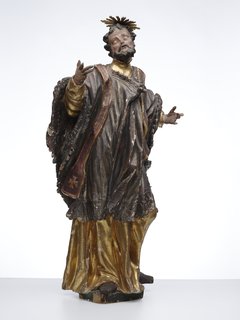
The sculpture of St Francis Xavier, Universalmuseum Joanneum, Alte Galerie, Inv.-Nr. P 186
Type
Sculpture
Dimensions
Height: 42 cm, width: 83,5 cm, depth: 23 cm
Critical History
The sculpture was bought at the same time as St Sebastian and St John of Nepomuk with an altar 1913 from St Radegund.
Wilhelm Suida1 published the sculptures (Styrian, 18th cent.), Kurt Woisetschläger2 dated them about 1750. First attribution to Philipp Jakob Straub is hereby done by Christine Rabensteiner, who dates them circa 1740 – 1750.
The sculpture shows a bearded St Francis Xavier in a moving position, his head turned and looking to heaven. The dalmatic is moving expressively.
The sculpture was situated on the right side of St Sebastian on the right side of the altar.
Construction / Execution
Three-dimensional, lime wood, with lime wood additions (three on the left side, two on the right side), polychromed with some local restorations
On the bottom of the plinth the sculpture shows exactly the same clamping hole as the sculptures of St Sebastian, Inv.-Nr. P 336 and St John of Nepomuk, Inv.-Nr. 337. This means, all three sculptures were made on the same construction unit.
The hands of the sculpture were done seperately, as well as the lower part of the stola, too.
Fabrication (clamping) hole on top (head) visible.
In the clamping hole the Nimbus was fixed.
The lower part of the stola is missing today, the garment on the left side is broken.
The sculpture was treated in 1961 with Xylamon (historical treatment against woodworm infestation), which was mentioned on the backside of the sculpture.
Two fingers at the left hand are missing, three fingers on the right hand are missing.
The hands are fixed both new but unfortunately not appropriate with Polyvinylacetate glue.
Components
- Sculpture
- Author: Philipp Jakob Straub (Wiesensteig 1706 – Graz 1774)
- Completed: 1740 – 1750
- Technique(s): wood carving
- Material(s): limewood
- Polychromy
- Completed: 1740 – 1750
- Material(s): calcium carbonate, calcium sulphate dihydrate, gold leaf, oil colour, red bole, silver leaf
Conservation-restoration
- 2018
Approach to the presentation of losses
Reconstruction of losses: partial
Repolychroming: partial
Materials: oil colour, PVA adhesive
Treatment Description
The original polychromy can be seen today (even if there are a lot of lacunae and missing parts). Silver parts: oxidated. Gilding: original with local, partially fillings with calcium carbonate with proteinous binding media. Then local, partially new gilding on fillings.
Incarnate: original
Krapplacklustre: perhaps later
base, shoes: retouched, overpainted
Historical reparations: broken part of the garment fixed with cloth and nails; hands glued with PVAc glue; retouched (bronze, oil-paint) and overpainted areas
Some fillings with calcium carbonate with proteinous binding media. Then local, partially new gilding on fillings. The little new gilded parts on the garment were executed over red bolus and polished with achate.
Images
- The sculpture of St Francis Xavier, Universalmuseum Joanneum, Alte Galerie (photo by Nicolas Lackner, Universalmuseum Joanneum, Graz, 2018)
- The sculpture of St Francis Xavier, Universalmuseum Joanneum, Alte Galerie (photo by Nicolas Lackner, Universalmuseum Joanneum, Graz, 2018)
Catalogue entry prepared by Paul-Bernhard Eipper and Christine Rabensteiner
Recommended citation: Paul-Bernhard Eipper and Christine Rabensteiner, The sculpture of St Francis Xavier, Universalmuseum Joanneum, Alte Galerie, Inv.-Nr. P 186, in: TrArS – Tracing the Art of the Straub Family, 2018, (accessed 01/07/2026) URL
